When Big Projects Pause, the Housing Market Still Moves
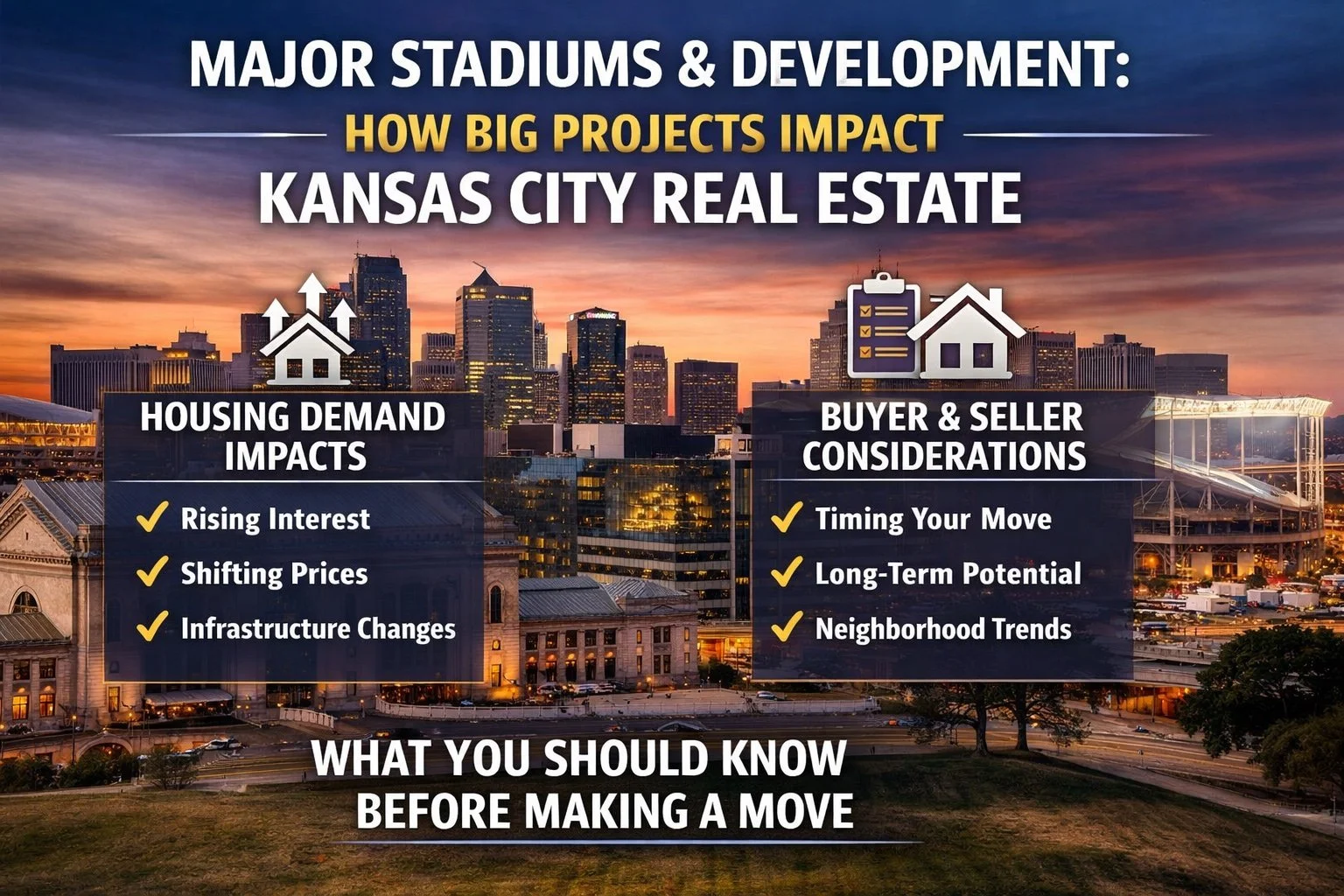
Lately, we’re seeing more conversations around large civic projects and what they might mean for housing across the Kansas City metro. Stadium discussions, infrastructure conversations, and development plans tend to capture headlines quickly, but the way they actually influence residential real estate tends to be quieter and far slower than most people expect.
A question we’re hearing more often from buyers and sellers is whether a major project announcement or delay should change their timing or neighborhood decisions. It is a reasonable question. When people hear about potential new development tied to sports venues or entertainment districts, it is easy to assume the surrounding housing market will shift overnight.
In real transactions, this shows up differently. Housing decisions move at a human pace. Families still make choices based on commute patterns, school districts, lifestyle preferences, and long term stability. Large civic projects may shape the future of an area, but they rarely reshape the next twelve months of housing activity the way people imagine.
The Long Horizon of Stadium Projects
One pattern that keeps coming up is how long major civic developments actually take to materialize. Stadiums, entertainment districts, and infrastructure projects typically move through years of political negotiation, funding conversations, design phases, and regulatory approvals before construction even begins.
Where people are getting tripped up right now is assuming that a potential development instantly transforms a neighborhood’s housing dynamics. The reality is that residential demand tends to move far ahead of construction timelines.
In real transactions, this shows up as buyers asking whether they should wait for a project to be finalized before purchasing nearby. Recently, we worked with a family considering two different parts of the metro. One area had ongoing discussion about a future entertainment district tied to sports activity, while the other offered established neighborhoods with mature amenities already in place. They ultimately chose the established area because their daily lifestyle needs were clear today, even if the other location might evolve later.
The tradeoff here is timing versus certainty. Waiting for a major project to fully materialize can mean sitting on the sidelines for years, while established neighborhoods continue evolving in quieter but steady ways.
Looking out five years, the areas that perform best are rarely the ones reacting to a single project announcement. They are the ones with durable demand drivers already in place such as employment hubs, transportation access, schools, and established community identity.
Neighborhood Psychology Moves Faster Than Construction
Another pattern we’re noticing involves perception shifts within neighborhoods when large development conversations enter the public discussion. Even before a project becomes real, it can change how people talk about an area.
The part that deserves more attention is how neighborhood psychology influences buyer behavior long before construction begins. Sometimes enthusiasm grows quickly, and other times uncertainty causes hesitation.
In real transactions, this shows up as sellers wondering whether they should list sooner or wait for future momentum. We recently spoke with homeowners near an area being discussed for future redevelopment. Their concern was whether values might jump dramatically if the project eventually moves forward. At the same time, buyers touring the same homes were asking a different question entirely. They were trying to determine whether the neighborhood would change in ways that alter its character.
The tradeoff is optimism versus predictability. Some buyers are energized by the idea of transformation and want to participate early. Others prefer neighborhoods where the future is easier to visualize.
Five years from now, most housing demand will still gravitate toward areas that balance stability with gradual improvement rather than dramatic reinvention.
Public Financing Conversations Create Temporary Noise
Large civic projects often depend on complicated funding structures involving public and private investment. These conversations tend to unfold in phases, and each phase can generate its own wave of speculation.
A question we are hearing more often involves whether uncertainty around funding or approvals should influence housing decisions nearby. The truth is that the housing market tends to absorb these discussions without dramatic disruption.
In real transactions, this shows up as buyers asking whether property values could stall if a major project becomes delayed. Recently, we worked with a relocating professional evaluating homes across several parts of the metro. One neighborhood had ongoing civic conversations tied to a future venue concept. Another had no major announcements but strong established demand. The buyer ultimately chose the neighborhood with existing infrastructure because the fundamentals felt clearer.
The tradeoff is anticipation versus reliability. Betting heavily on a future catalyst can work well if the project eventually materializes exactly as envisioned. But housing markets tend to reward steady fundamentals more consistently than speculative expectations.
Five years out, the most resilient neighborhoods will be those supported by diverse economic drivers rather than a single marquee development.
Mobility and Infrastructure Quietly Shape Housing Decisions
While stadium conversations tend to dominate attention, the underlying factor influencing residential decisions is often transportation and daily mobility.
Lately, we’re seeing buyers focus less on proximity to a single destination and more on how easily they can move throughout the metro. Access to highways, commuting flexibility, proximity to employment centers, and lifestyle convenience often outweigh the excitement surrounding a future venue.
In real transactions, this shows up when buyers compare two homes that are otherwise similar. One may be closer to a proposed development district, while the other offers easier access to major roadways and daily conveniences. More often than not, the second option wins.
The tradeoff here is energy versus practicality. Entertainment districts and sports venues create vibrant moments for a city, but families evaluate housing decisions based on everyday routines rather than occasional events.
Looking forward five years, neighborhoods that remain easiest to live in day to day will continue attracting the most consistent buyer demand regardless of where major projects ultimately land.
What This Means If You’re Actually Moving
• Do not assume that a major civic project will immediately transform nearby housing markets
• Focus first on daily lifestyle factors such as commute patterns, schools, and neighborhood stability
• Understand that development timelines often stretch far longer than initial public conversations suggest
• Recognize that buyer demand typically follows established infrastructure more than speculative future projects
• Consider whether you are personally comfortable with uncertainty around future neighborhood change
• Remember that housing markets tend to reward steady fundamentals over short term excitement
• Evaluate each neighborhood based on how well it supports your life today, not just potential headlines tomorrow
The Fosgate Perspective
The misunderstanding we quietly see most often is the belief that large civic projects instantly reshape residential real estate. In practice, housing markets move more slowly and more thoughtfully than headlines suggest. The clients who tend to feel most confident five years later are the ones who focused less on speculation and more on how a neighborhood actually supports their day to day life. Big projects can certainly influence a city’s future, but the homes people feel best about are usually chosen for reasons that already exist.