Why Your Home’s First Showing Now Happens Before Anyone Walks Through the Door
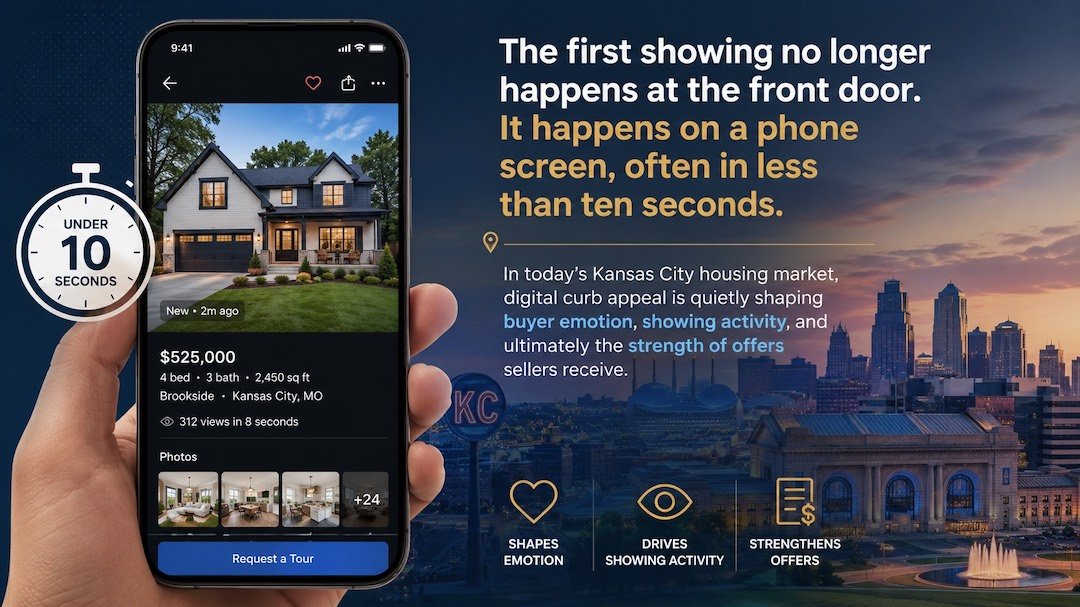
A family sits on the couch in Overland Park after dinner, scrolling through listings on a phone. A relocating buyer in Denver opens three tabs while waiting to board a flight. Someone in Lee’s Summit looks at homes during a lunch break between meetings. Another buyer, exhausted after months of searching, decides within eight seconds whether a property feels worth seeing.
None of them are standing in the driveway.
The first showing already happened.
For decades, curb appeal meant trimmed landscaping, fresh mulch, and a welcoming front porch. Those details still matter. But in today’s housing market, especially across the Kansas City metro where buyers are balancing higher monthly payments with limited time and growing expectations, the real first impression is happening on a screen.
And increasingly, that digital impression determines whether a buyer ever schedules the physical showing at all.
The homes that create emotional momentum online are the homes that generate urgency. The homes that fail digitally often struggle long before anyone notices why.
The New Psychology of Home Shopping
Modern buyers do not browse listings the way buyers did even five years ago. They move faster, filter harder, and make emotional judgments almost instantly.
This is not superficial behavior. It is adaptive behavior.
Kansas City buyers today are managing a market filled with economic uncertainty, elevated interest rates, and a constant flood of information. Many are juggling work schedules, school calendars, long commutes, and affordability pressures. By the time they open Zillow or Realtor.com at night, they are not leisurely window shopping. They are trying to reduce decision fatigue.
That means every listing is competing for emotional attention before it ever competes on price.
The strongest listings create clarity immediately. Buyers can understand the layout. They can picture themselves in the home. They feel calm instead of confused. The property feels aspirational but believable.
Poor digital presentation creates the opposite effect. Dark photos make rooms feel smaller. Clutter creates visual stress. Awkward camera angles make buyers question the floor plan. Missing information forces uncertainty.
Most buyers will not consciously articulate any of this. They simply keep scrolling.
Research continues to reinforce how powerful this shift has become. A growing percentage of buyers say they would feel comfortable making an offer after only viewing a virtual tour online. Listings with immersive media and stronger visual presentation consistently receive significantly higher engagement than comparable homes without it.
In practical terms, digital curb appeal is no longer marketing fluff. It is now part of the pricing strategy.
The Listings That Quietly Win
Some homes enter the market and immediately feel different.
You notice it before checking the price. Before reading the description. Before even seeing all the photos.
The listing feels composed.
The lighting looks natural. The spaces feel open. The transitions between rooms make sense. Buyers subconsciously feel oriented inside the home before physically visiting it.
That emotional ease matters more than most sellers realize.
In the Kansas City market, where buyers often compare suburban newer construction against older established neighborhoods like Brookside, Waldo, Prairie Village, or Liberty, presentation becomes especially important. Older homes frequently win online when they communicate warmth, character, and intentionality. Newer homes often win when they communicate simplicity and clean functionality.
Neither succeeds accidentally.
The strongest digital listings are carefully choreographed. Furniture placement is intentional. Window coverings are adjusted for light. Wide-angle photography is used carefully without distorting reality. Virtual tours create flow rather than confusion. Interactive floor plans remove uncertainty before buyers ever arrive.
This matters because uncertainty is expensive in real estate.
When buyers cannot mentally “solve” a house online, they hesitate. Hesitation slows showing activity. Reduced showing activity weakens perceived demand. Weak demand eventually affects negotiating leverage.
The market rarely announces this directly. Sellers simply feel that momentum never arrived.
And often, the problem started with the listing presentation itself.
Why Professional Photography Is No Longer Optional
There was a time when cellphone photos could survive in a hot market. Those days are fading quickly.
Today’s buyers are deeply conditioned by visual quality. Every major platform they use daily, from Instagram to YouTube to Airbnb, trains them to expect polished imagery. Real estate is no exception.
A poorly photographed home now signals something unintended: lack of preparation.
Even beautiful properties can appear unimpressive online when lighting is flat, composition is rushed, or rooms are photographed from awkward positions. Conversely, modest homes often outperform expectations because the visual storytelling feels thoughtful and emotionally inviting.
Professional photographers understand how to frame space, capture depth, and create emotional flow from image to image. They know how natural light changes a room. They understand lens distortion. They know which angles make buyers feel pulled into a property rather than held at a distance.
That expertise has become increasingly important in Kansas City’s competitive suburban markets, where buyers may compare dozens of similarly priced homes in a single evening online.
The homes that feel visually effortless usually are not effortless at all.
Behind the scenes, they are carefully prepared.
Decluttering becomes strategic rather than cosmetic. Personal items are reduced not because sellers lack personality, but because buyers need room to project their own lives into the space. Furniture is sometimes removed entirely to improve sightlines and scale perception.
These details sound small until they are viewed through a screen.
Then they become enormous.
The Rise of the “Invisible Showing”
One of the most interesting shifts happening in real estate right now is the growing number of buyers who mentally eliminate homes before ever stepping inside.
Agents across the Kansas City metro see this constantly.
A home receives very few showing requests despite being priced reasonably. Sellers assume the issue is the market. Sometimes it is. But often, buyers already toured the home digitally and quietly decided against it.
This is where immersive media has become transformative.
Interactive floor plans, high-quality virtual walkthroughs, and thoughtfully produced video tours reduce friction dramatically. Buyers no longer feel like they are guessing about room connections or home flow. They feel informed.
That confidence changes behavior.
Instead of casually browsing, buyers begin emotionally advancing toward the property. By the time they physically visit, they are often confirming a positive impression rather than forming a first one.
This changes the emotional tone of the showing itself.
The strongest listings create familiarity before arrival. Buyers walk in already oriented. Already attached. Already imagining furniture placement, routines, and future memories.
That emotional head start matters.
Especially in Kansas City neighborhoods where inventory remains competitive in desirable price ranges, buyers frequently decide within minutes whether they are emotionally pursuing a property. Digital presentation now shapes that outcome long before the front door opens.
A Quiet Advantage Sellers Often Overlook
Many sellers still view marketing as an accessory to the transaction.
In reality, marketing shapes the transaction.
Homes that create stronger emotional engagement online typically generate better early activity. Better early activity creates stronger perceived demand. Stronger demand improves negotiating position and reduces the likelihood of painful price reductions later.
This does not mean every seller needs luxury-level staging or extravagant production budgets.
It means intentionality matters.
A clean, thoughtfully prepared home with excellent photography and strong digital presentation will often outperform a superior property that feels rushed online.
That truth can feel frustrating because it sounds unfair. But buyers are human beings, not spreadsheets. Emotion drives attention. Attention drives showings. Showings drive offers.
The market has always worked this way.
The difference now is that the emotional first impression happens digitally.
And increasingly, it happens fast.
For sellers navigating the Kansas City market, understanding that shift is no longer optional. It is part of protecting value in a world where buyers often decide how they feel about a home before ever pulling into the driveway.
The best agents understand this deeply. They recognize that modern marketing is not about flashy gimmicks or social media theatrics. It is about reducing uncertainty, building emotional connection, and helping buyers imagine a future inside the home.
That requires experience, judgment, and restraint.
At Team Fosgate Real Estate, those conversations happen every day with sellers across the Kansas City metro. Not just about pricing or timing, but about presentation, buyer psychology, and the subtle details that influence how a home is perceived online. In a market where first impressions increasingly happen through a screen, thoughtful guidance has never mattered more.